Partnered Pony Blog

Posts tagged horse racing
Kentucky Derby Milestone

This year’s Kentucky Derby horse race was considered a milestone in the event’s history.  It wasn’t because the winner Golden Tempo was a longshot who won a come-from-behind victory.  It was because Golden Tempo’s trainer is a woman; she’s the first woman trainer to win the Derby.  For me, though, that wasn’t what impressed me. It was the way Cherie DeVaux talked about the horse.
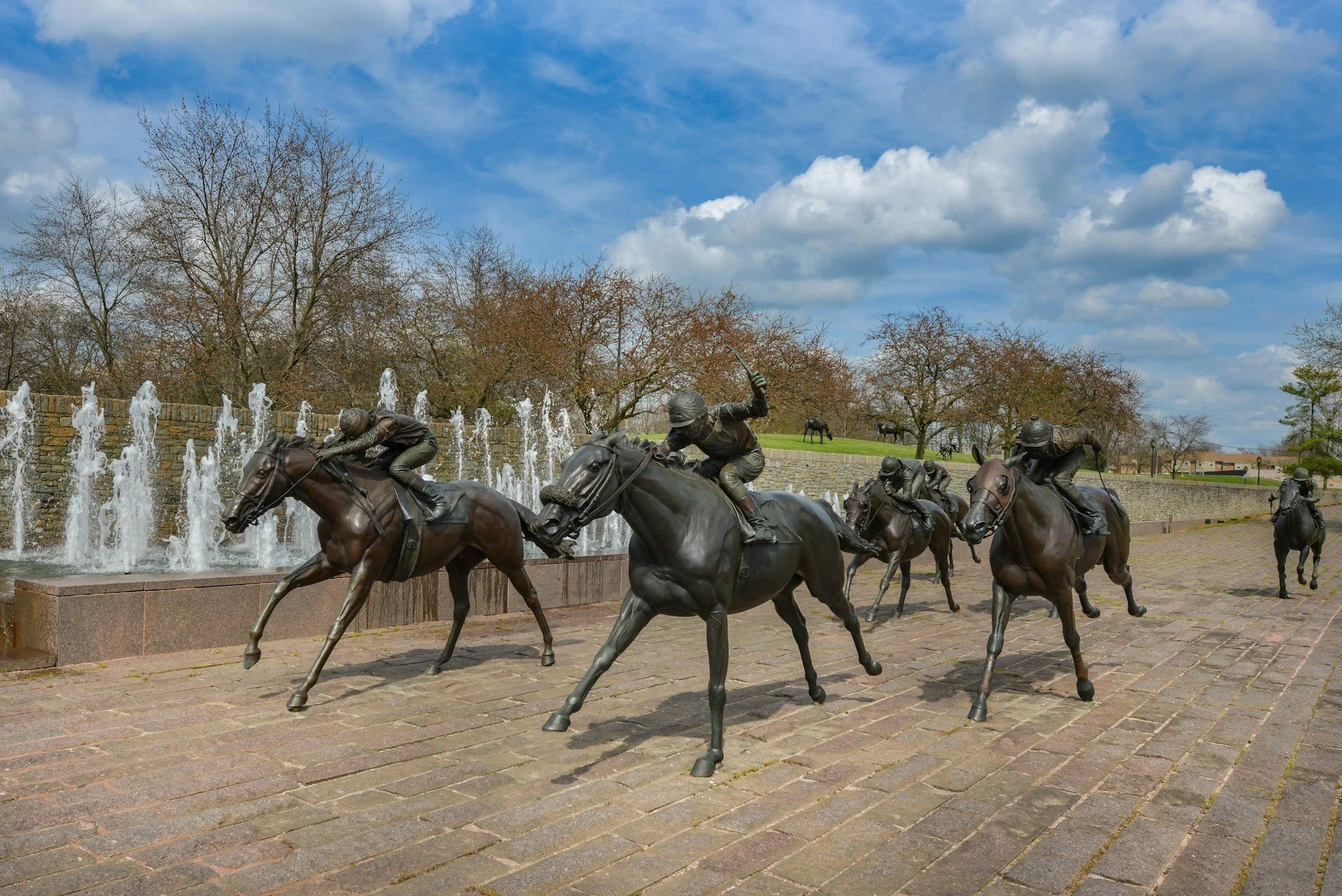
Thoroughbred Park, Lexington Kentucky. Photo by Cristina Anne Costello on Unsplash

 This year’s Derby was the 152nd running of the race.  Devaux’s comments after the race put the horse first: “I’m just so, so, so happy for Golden Tempo… .”  And then, “Training Golden Tempo has really been a treat.  There’s not a lot of times when a colt that is as big as he is, is as pleasurable as he is. He is just such a consummate professional. He’s got a wonderful personality, so really, he allowed us to train him, and he responded to what we asked him to do throughout each process. He improved each race. We trained him a bit hard in between, and he showed up for us every time.” (1)

 The Kentucky Derby is the first race in the sport’s Triple Crown.  When DeVaux was asked whether her winner would run in the Preakness, the next race in the Triple Crown, she said, “We’re gonna let him decide that. We’re gonna see how he looks tomorrow and subsequently in the next couple of days, but we’re going to have to allow him to tell us because the horse is first. We’re not here for ourselves. We’re not here for our egos. We’re here for the horse.” (1)

 And the trainer’s language about putting the horse first remained present a few days later when the stable made the decision for Golden Tempo to skip the second race in the Triple Crown:  “Golden gave us the race of a lifetime in the Kentucky Derby, and we believe the best decision for him moving forward is to give him a little more time following such a tremendous effort.” (2)

 Regarding the glass ceiling DeVaux broke at the Kentucky Derby, she said, “I’m glad that I can be a representative of all women everywhere.  That we can do anything we set our minds to.” (1)  She continued, “It really is an honor to be able to be that person for other women or other little girls to look up to. You can dream big or you can pivot. You can come from one place, and you can make yourself a part of history.” (3)

 So often when we set out to accomplish something with our equine partners, the goal can get in the way of the partnership.  To hear someone at this level of equine sport put the horse first and really demonstrate they mean it after topping their profession is something worth celebrating indeed.

  1. Ohman, Emily, and Dan Santaromita. “Golden Tempo Wins Kentucky Derby, Giving Trainer Cherie DeVaux Historic Victory.” The New York Times, May 3, 2026. https://www.nytimes.com/athletic/7247234/2026/05/02/kentucky-derby-winner-results-payouts-golden-tempo-2026/

  2. Powell, Zach. “Golden Tempo Will Skip Preakness after Historic Kentucky Derby Win.” The New York Times, May 11, 2026. https://www.nytimes.com/athletic/7252748/2026/05/06/preakness-stakes-golden-tempo-race-2026/.

  3. Ohman, Emily, and Dan Santaromita. “How Cherie DeVaux Went from ‘Wild Child’ Premed Student to Kentucky Derby-Winning Trainer.” The New York Times, May 3, 2026. https://www.nytimes.com/athletic/7249213/2026/05/02/cherie-devaux-female-trainer-kentucky-derby-winner/
Shetlands and Thoroughbreds and Galloways

Several years ago, an article with a sensational headline was posted on the internet:  “Shetland pony behind Thoroughbred Speed.”  It was quickly pointed out that the headline had no support in the text of the article, which was indeed about the source of speed in the Thoroughbred.  At the time, research based on DNA analysis had provided information on the genetic basis of the breed’s speed.  Fast forward several years, and the actual research paper finally crossed my desk.  Not only did it become clear why Shetlands were called out in the erroneous headline, but also the article contained a surprise:  Galloways, often linked to Fell Ponies, were called out too.  In addition, Connemara and Highland Ponies were part of the research data set. (1)

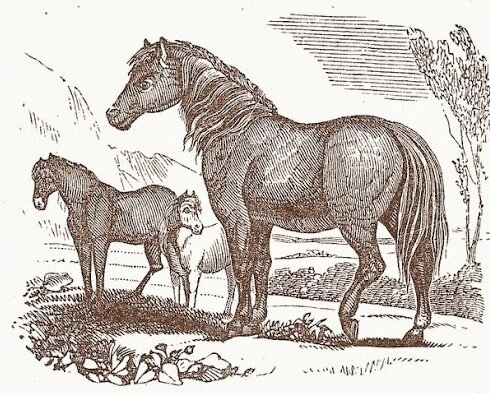
Galloways as pictured in Oliver Goldsmith’s 1774 book Earth and Animated Nature

Galloways as pictured in Oliver Goldsmith’s 1774 book Earth and Animated Nature

The researchers, based in England, Ireland and Sweden, both in academia and private industry, studied a gene that has one of two expressions:  sprint speed (C allele) or stayer/endurance (T allele).  They found that the C-allele is “not restricted to the Thoroughbred and Thoroughbred derived populations, is not a new mutation, and seems to occur at variable frequencies depending on the selection pressures on the population.” 

The history of the Thoroughbred suggests that the stayer/endurance type equine would have been more favored in earlier times when races were longer and several heats were run, whereas sprinters are more favored in modern times when single races over relatively short distances are run.  The Thoroughbred is interesting to study because it has had a closed stud book since 1791, so the researchers point out that the C-allele must have been present at the founding of the breed, but that it has been concentrated in modern times by selective breeding. 

The researchers were able to sample past significant Thoroughbred sires, such as Eclipse foaled in 1764, to learn that all of the historic sires were homozygous for the stayer gene.  Then using pedigree analysis of modern day sprinter versus stayer horses and doing DNA analysis of them, the researchers concluded that the C-allele was introduced as a founding event on the female side, from perhaps a single mare.   Since the breed was created in England, a British mare or mares is therefore assumed to be the source of the speed gene (C-allele).

In addition to looking at the presence of the sprinter and stayer genes in Thoroughbreds, the researchers also sampled numerous other types of equines to try to determine where the sprinter gene may have come from.  Donkeys and zebras were found to have no sprinter genes (all stayers T/T).  In fact the only sample where sprinter genes were dominant and homozygous was in the Quarter Horse where 83% of the samples were C/C, compared to only 22% of Thoroughbreds over all.  Modern sprinter type Thoroughbreds were homozygous for the sprinter gene in only 46% of samples.  So it was surprising to learn that the Shetland pony samples had an average of 34% homozygous sprinter alleles (C/C).  The headline writer can be forgiven for leaping to their erroneous conclusion of a link via speed between Shetlands and Thoroughbreds!  No other equine group that was sampled, outside Thoroughbreds and Quarter Horses, had as high a percentage of homozygous sprinters nor as high a frequency of the C allele as the Shetland.  I found this quite amazing.  Keep in mind, though, that there were lots of breeds that were not included in the research.

Most equine enthusiasts are aware of the three legendary founding sires of the Thoroughbred:  The Godolphin Arabian, the Darley Arabian, and the Byerly Turk.  Equine researcher Deb Bennett, PhD, has posited that the English Hobby, an extinct breed/type, populated the female side of early Thoroughbred pedigrees.  Because the Hobbies crossed so well with the eastern sires, breeds created from the cross survived down through time while the Hobby was lost.  Yet some of those breeds also suffered extinction from their own success as crosses, including the Scottish Galloway, according to Bennett.  (2)

The researchers mention the Galloway in a context I was not previously familiar with: “…the Galloway breed, which was the preeminent British racing population before the formal foundation of the Thoroughbred breed.”  I had never before heard of Galloways as formal racers.  Informal, yes, as the mounts of the Border Reivers, but I was not aware of the history of racing before the Thoroughbred.  Miriam Bibby, who many Fell Pony enthusiasts know through her association with History on Horseback, contributed to the book The Horse in Pre-modern European Culture.  She says there that formal racing began at the Scottish/English border in the late 16th century. The Fell Pony Museum cites an announcement in the Newcastle Courant for a race at Penrith on June 17, 1736 exclusively for Galloways.

I found the following statement by the researchers problematic:  “The Shetland is closely-related (at least geographically) to the Galloway…”  First, there are other breeds that the Shetland is closer to geographically, such as the Highland Pony in the north of Scotland.  The historic range of the Galloway is towards the south of Scotland, often particularly along the Solway Firth.  And second, genetic research often links the Shetland breed more closely to the Nordic breeds than to the other British mountain and moorland breeds; the Shetland Islands are nearly as close to Norway as they are to Scotland. So it’s not clear to me that the Shetland and Galloway are very closely related.  I suspect the researchers made this statement to try to tie the Shetland to an early racing type that might have contributed the speed gene to the Thoroughbred.  The researchers could definitely have made better choices for comparison, however.  Bennett lists the following extant breeds similar to Galloways who are descended from Hobbies crossed on eastern sires:  “Welsh, Dartmoor, Asturian, Galician, Navarrese, Mérens, and Breton.”  Bennett says that the Irish Kerry Bog pony is the last remaining direct descendant of the Hobbies.

In addition to the Shetland, the researchers sampled two other mountain and moorland breeds:  the Highland and the Connemara.  In both these breeds, unlike the Shetland, the speed gene (C-allele) appeared in only 10% of samples with 86% of samples being homozygous for the stayer allele.  The Fell Pony is usually said to have significant endurance and is sometimes said to be related to the Highland.  These Highland results certainly lead one to believe that Fells are more stayer than sprinter.  The results for the Highland also distinguish it clearly from its near-neighbor the Shetland.

The Connemara hails from County Galway in Ireland.  When I mentioned the research about the speed gene to my friend Eddie McDonough, he recalled a song about horse races in Galway sung by the Dubliners.  I was struck by the lyrics that so easily conjured the excitement of a race day.  To listen, click here! I will continue to wonder if Galloways, while being known for speed, were truly sprinters or whether they were stayers like their modern mountain and moorland kin.

  1. Bower, Mim A., et al.  “The genetic origin and history of speed in the Thoroughbred racehorse,” Nature Communications, 1/24/12.

  2. Bennett, Deb, PhD.  “The World’s Most Important Horse Breed,” Equus #446, November 2014.

© Jenifer Morrissey, 2020

My book The Partnered Pony celebrates how ponies improve our world. The book is available internationally by clicking here or on the book cover.